

I write about what happens when AI meets the real world - the operating models, the people, and the messy bit in between. I'm Mark Strefford, founder of Reimagined Industries, and I've spent 20 years delivering technology-led transformation into organisations ranging from startups to Saudi's NEOM. If you're wondering why this is in your inbox, you probably signed up after one of my LinkedIn posts.
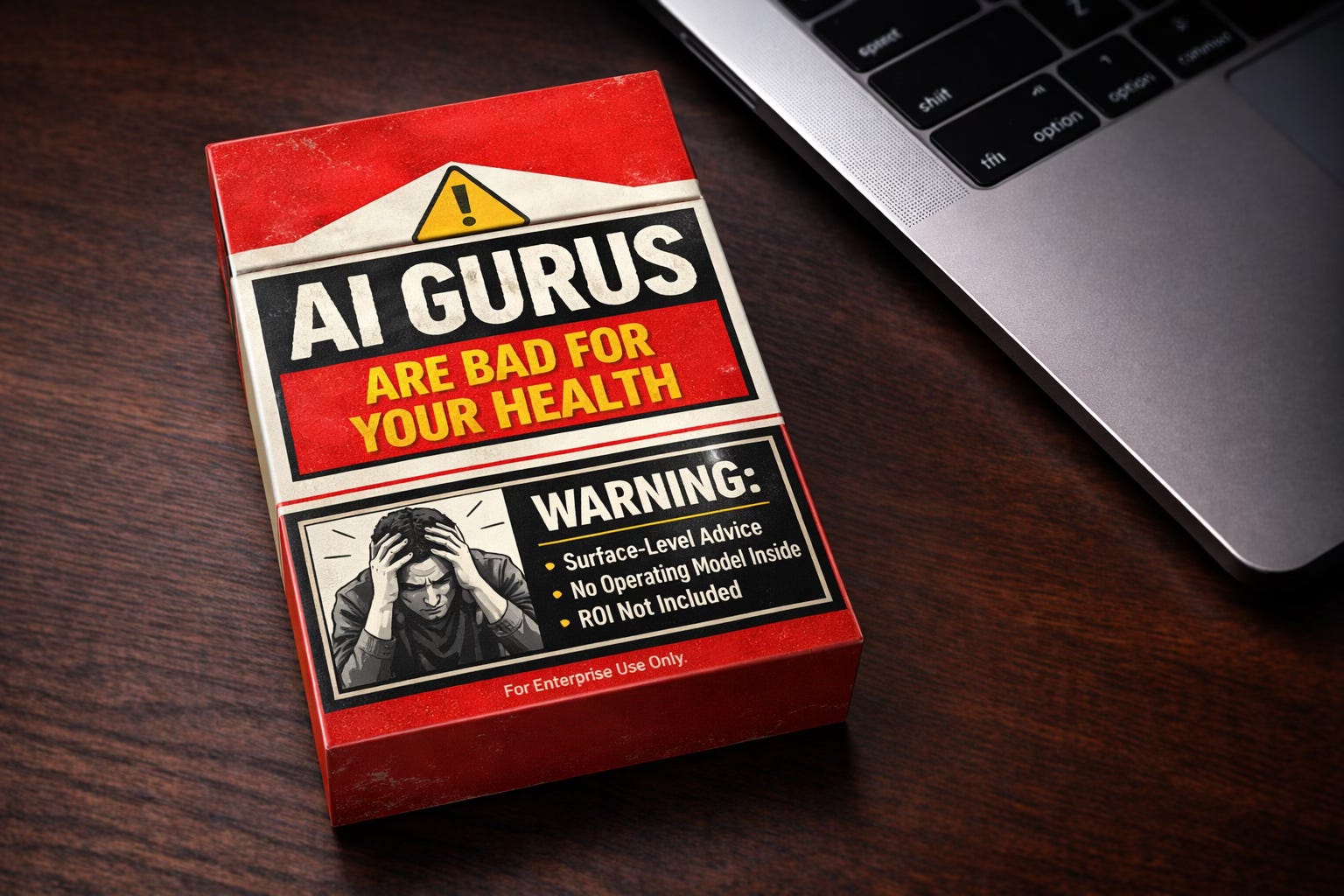
I smoked for years. And the one thing every non-smoker loved to tell me was “just stop smoking.” As if the thought had never occurred to me. As if the reason I hadn’t stopped was a lack of information.
Nobody in the history of mankind has ever calmed down from being told to calm down. And nobody has ever transformed how their company works because someone on a stage told them to “just use AI better.”
The AI guru circuit runs on this. Get ROI. Adopt faster. Be more strategic. It sounds helpful. It’s the corporate equivalent of “just eat less” said to someone who stress-eats every night after putting the kids to bed. Well meaning, completely substanceless.
The reasons people struggle with AI aren’t informational. They’re cultural, psychological, deeply human. People aren’t slow because they haven’t read the right LinkedIn post. They’re slow because this stuff makes them vulnerable in ways they can barely articulate.
I think most of us, whether we say it out loud or not, have looked at the press and wondered how long we’ll have jobs for. That’s not a question you answer with a webinar about prompt engineering.
Predictability has been hardwired into working life for decades. You knew roughly what your job looked like next year, roughly what your industry looked like in five. The internet changed things, mobile changed things again, but neither happened overnight. You had years to figure out whether you needed a website, years to decide whether your business needed an app. AI doesn’t give you years. And when the pace of change outstrips someone’s ability to process it, telling them to speed up isn’t strategy. It’s cruelty dressed up as advice.
ChatGPT has hundreds of millions of users, yet despite running an AI business, most of my close family and friends either treat it as a better Google or haven’t touched it at all. The gap between what’s happening at the frontier and what’s happening in most people’s actual lives is enormous. The gurus are speaking from one side of that gap to people standing on the other, and wondering why nobody moves.
Some people move fast with change. Some move slow. Neither is wrong. But telling someone on the slow side to “just adopt AI” is like telling someone who’s never run a mile to just run a marathon. The destination might be right. The advice is useless.
AI adoption is about leadership. It’s about change. And change, for most of us, is genuinely hard.
It’s why in my projects I spend as much time with the AI users as I do with the board and the dev team. I’ve been having conversations about “will AI take my job” with front line staff since 2017. And I’ve delivered the commercial benefit while helping people feel enthralled about using new tech, getting rid of the drudgery that nobody wanted to do in the first place.
Both are true. You can transform the business and bring the people with you. But it takes understanding where the resistance actually lives, which is almost never where the guru thinks it is.