

Most conversations about AI inside big organisations start from a hidden assumption.
That the organisation itself still exists in anything like its current form in 10 years.
I am not sure it does.
We built corporations because it was cheaper to do things inside the firm than to coordinate thousands of transactions in the market. Coordination had a cost. Contracts had a cost. Search had a cost. Trust had a cost.
AI agents crush those costs.
In an agentic world:
- people have their own personal agents
- those agents understand preferences, constraints, ethics and risk appetite
- they guard and use data on our behalf
- they discover options, assemble services, negotiate and handle the admin
- they can orchestrate transactions across hundreds of firms in seconds
If the cost of coordination tends to zero, so does the traditional advantage of the corporate.
Except where the underlying asset base is huge and physical. Think transport networks, energy infrastructure, heavy industry and a handful of other capital intensive sectors.
Those do not disappear. But the structure wrapped around them does not need to look like a 1980s conglomerate.
I have spent the last 20 years helping large organisations use data and technology to change how they work. Long before the current AI hype cycle, I was arguing that AI ROI had to start with the business problem, not the tools. Over and over I have seen the same pattern: leaders deprioritise structural risk while they chase short term efficiency wins.
The pattern is simple. Leaders optimise the wrong layer of the system.
Most AI roadmaps sit in the “efficiency inside today’s org chart” zone.
More pilots. More tools. More automation wrapped around legacy processes.
Useful, maybe. But it assumes the corporate structure is the thing to preserve.
What if that is the wrong problem?
If every customer, supplier and employee had their own powerful agents, would they still need your organisation, or would they route around it?
If your confidence rests on:
- long or complex contracts
- “owning” the customer relationship or channel
- being the default option inside someone else’s bundle or framework
- processes and systems that make switching slow or painful
then your moat is friction.
And agents are designed to remove friction.
They will route around any node in the network that does not deliver clear value, reliability and trust.
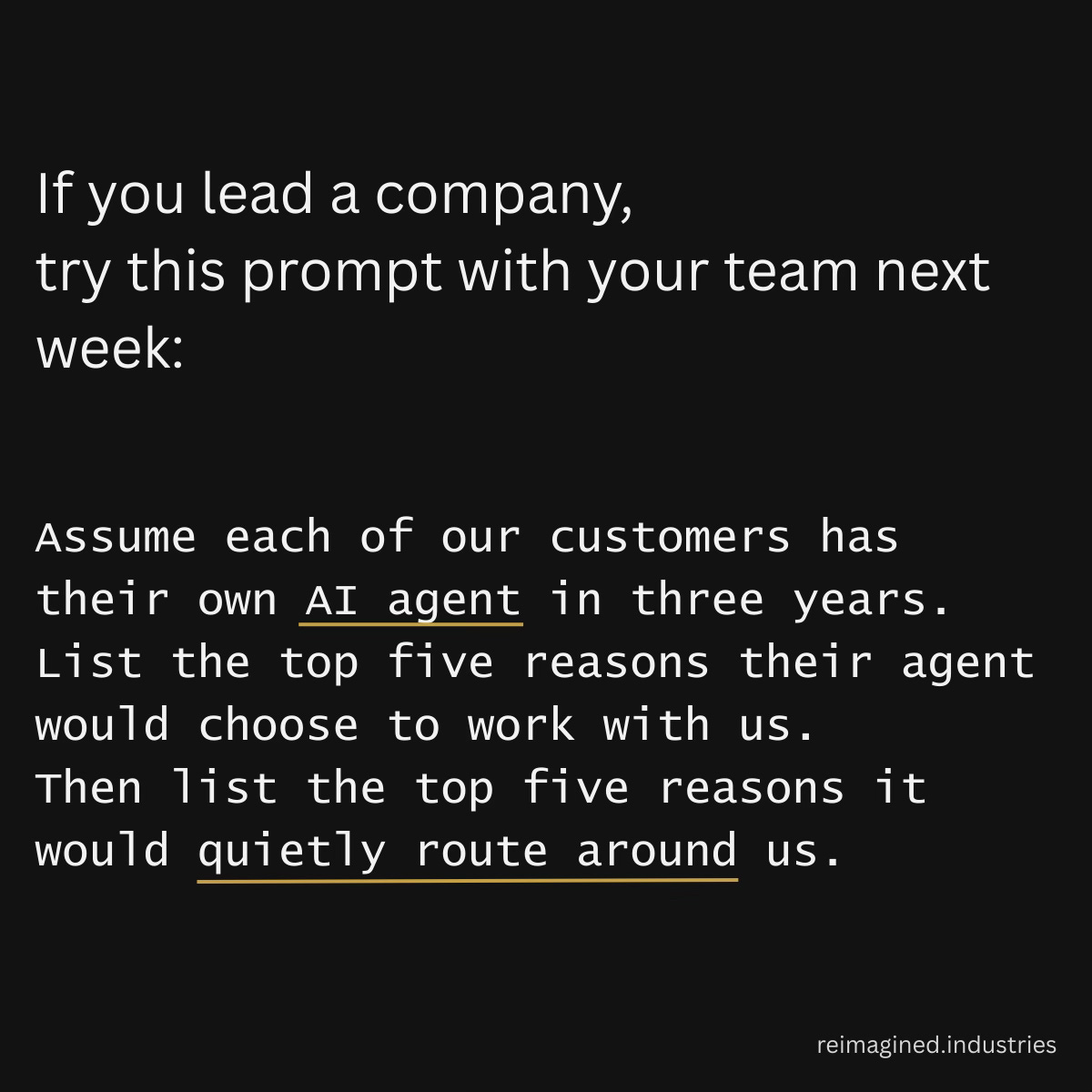
If you are a CEO, CFO or CTO, try this prompt with your team next week:
“Assume every one of our customers has their own AI agent in three years.
List the top five reasons their agent would choose to work with us.
Then list the top five reasons it would quietly route around us.”
The gap between those two lists is where your real strategy work starts.